If It Moves, We Will See It and We Will Kill It" — Two Hours with the 12th Vice Chairman
Posted by Steve Cassidy on Oct 20, 2026
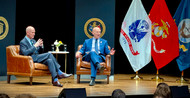
Last Friday I sat in a Vanderbilt auditorium and listened to Admiral Chris Grady, USN (Ret.), the 12th Vice Chairman of the Joint Chiefs of Staff, talk for two hours without a slide deck.
He was there for the 16th Annual Vanderbilt National Security Symposium, hosted by the Institute of National Security and the NROTC Alumni Association, in conversation with Admiral Frank Caldwell, who ran Naval Reactors for eight years. The room was mostly midshipmen and cadets who commission in the next year or two. I build equipment for people who walk toward the thing everyone else runs from, so I went to listen.
One note before I start. He spoke candidly about operations underway right now, and I am not going to relay that part. It was a conversation with students, not a press conference, and rooms like that only stay honest if people keep them that way. What follows is the part that will still be true in ten years.
No single instrument of national power works alone.
He kept coming back to the four tools: diplomatic, informational, military, economic. Asked directly what role diplomacy plays, he said it should lead — and then explained honestly why it often does not. Diplomacy runs on relationships and trust, and those take time. So the table turns to Defense and asks what can be done now. He called the military the country's big red easy button, and he did not mean it as a compliment.
China is the pacing threat, and one of the dates is close.
He separated two timelines that get blurred constantly. Beijing's political milestone is 2049. But Xi's direction to the PLA is to have the capability regarding Taiwan by 2027. Grady did that arithmetic out loud for the room. About two months away — and he allowed it may slip.
The line I will be chewing on for a year.
He pushed back on a framing used earlier in the day. The nature of war does not change — it is bloody and awful and always will be. The character of war changes constantly, and the defining change of this era is battlespace transparency.
If you move on the surface of the earth — ocean, land, or air — we will see you and we will kill you. And so will they.
That is a hiders-versus-finders world, and it puts everything on two domains. Space, because that is where the finding happens. And the undersea, because water is still opaque and nobody detects reliably below about 500 feet with any consistency. Quantum sensing may change that eventually. Not yet. He argued that margin is the one clear advantage we hold, and we had better protect it.
Do not learn the wrong lesson from Ukraine.
His second imperative was robotic and autonomous systems, and he refused the either/or. Not all exquisite platforms. Not all cheap attritable mass. A balance — and finding it across the distances of the Western Pacific is the real problem.
He pounded the table on scale, because this is where people get it wrong. The Donbas is compressed terrain. The Pacific is not. His illustration: the Arabian Gulf fits inside the Gulf of Thailand. The drone lessons from Ukraine are real but partial, and transplanting them wholesale into the Pacific is an error.
The bill from 1993.
This is where I sat up, because it is my industry. Admiral Caldwell described the Last Supper — the 1993 Pentagon dinner where defense contractors were told there was not enough work and they would have to sort out among themselves who survived. Nineteen primes became about five.
Grady's version was a number. We envisioned thirty-plus Seawolf-class submarines. Mean, fast, deep-diving, lethal. We built three. Submarine construction stopped, yards closed, work went overseas, and a manufacturing economy became a service economy. His view: there was no peace dividend. America has a responsibility on the world stage, there is a baseline defense required to meet it, and rebuilding that capacity is itself part of the competition.
He was open about what it costs. Roughly $1.15 trillion today is a little over 3% of GDP. The commitment on the table is 5% by 2030, which on a projected $37.7 trillion economy works out to about $1.89 trillion. He laid the numbers down and let the room do the math.
And then he spent the last half hour on people.
After all of that — orbital warfare, submarine detection, trillion-dollar toplines — what he actually wanted the future officers to hear was about sailors.
In most militaries around the world, officers do nearly everything and the enlisted ranks are treated as expendable. In ours, sailors maintain and fight the ship. He called that the secret sauce and said flatly it is why we win if it comes to it. He also acknowledged the equipment margin is narrowing. The culture margin is not.
He gave two rules for building a team that will tell you what you need to hear.
Never condescend to them. They will ask hard questions and they deserve real answers, and if you talk down to them once, the good ideas stop arriving.
And have the courage not to be the smartest person in the room. He asked how many of us had sat in a meeting with someone at the head of the table who had to be the smartest one there. Every hand went up. For an ensign that means asking the chief to walk you through it. For a four-star it means saying out loud that you do not understand the brief and the team needs to come back. He said most senior leaders will not do that, and will burn somebody at the table instead.
I have run a company long enough to know he is right, and long enough to know how hard the second one is.
Why any of it matters.
Asked about the economics of security, he gave the students the sentence I think he came to deliver: the reason the military does what it does is to create a security and stability environment in which economies can flourish.
Liberty is not free. That is the work of the one percent who choose to serve.
My thanks to the Vanderbilt Institute of National Security and the NROTC Alumni Association for putting this on, and to Admiral Grady for 42 years of service and for an afternoon of straight answers.
To the midshipmen and cadets in that room: you are inheriting a harder problem than the one he inherited. He seemed to think you are up to it. So do I.