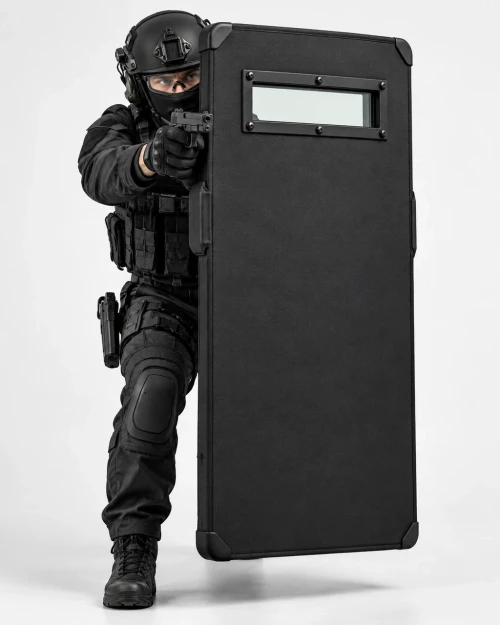
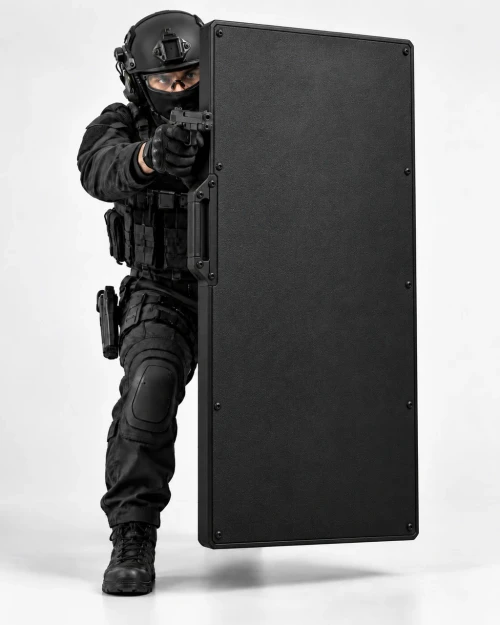
A viewport changes how a shield gets used. Without one, the operator either works blind behind the panel or breaks the sightline to see. With one, they hold cover and keep eyes on the threat through the approach.
That single decision drives most of the others — panel size, cut, weight, where the handle sits. We carry Level IIIA shields with viewports in several configurations, and the right one depends on who is carrying it and what they are walking into. Tell us the mission and we will spec it.
Request a Quote
Typical response: one business day.
What Level IIIA covers — and where it stops
NIJ Level IIIA is the handgun and fragmentation rating. Under NIJ 0108.01 it addresses the common duty and street threats:
- 9x19mm FMJ
- .40 S&W FMJ
- .45 ACP
- .357 Magnum JSP
- .357 SIG FMJ
- .44 Magnum SJHP
- 5.7x28mm
- 12 ga. slug
Level IIIA does not stop rifle rounds. If your threat assessment includes 5.56 or 7.62, you need a Level III or III+ panel, and the weight and cost both move. This is the single most common mismatch we correct on an incoming quote request, so it is worth settling before anything else.
If you are not sure which side of that line your team falls on, that is a conversation worth having. We will give you a straight answer even when it points at the lighter, cheaper shield.
What the viewport actually buys you
- Sustained cover during approach. The operator does not have to choose between seeing and being covered.
- Communication. Hand signals and eye contact with the stack stay available behind the panel.
- De-escalation. On a barricade or a welfare check, being able to see and be seen changes the dynamic.
- Low-light integration. Most viewport shields pair with a weapon-light or shield-mounted lighting setup. Plan for that mount at purchase, not after.
The trade-off is real: a viewport is a cut in the panel, and the aperture is covered by transparent armor that adds weight over that area. Different builds handle this differently. That is part of what we will walk you through.
How to spec the right shield
Six questions decide it. Have these answers ready and the quote comes back fast.
- Threat profile. Handgun only, or do you need rifle-rated? This sets IIIA vs. III/III+ and everything downstream.
- Mission. Patrol car carry, SWAT entry, bomb squad approach, school resource officer, courthouse or facility post. Each pulls toward a different size and weight.
- Carry time. Minutes on a dynamic entry is a different shield than an hour on a perimeter.
- Size and coverage. Larger panels cover more and move slower. Where your team lands depends on tactics, not preference.
- Lighting and accessories. Light mount, strobe, handle configuration, carry strap, storage case, tactical cover.
- Procurement path. GSA, purchase order, P-card, or credit card. We are a GSA contract holder, and knowing the path up front removes a week from the cycle.
Who we spec shields for
Patrol units needing a car-carried shield. SWAT and tactical response teams. Bomb squads and EOD elements working approach problems. School resource officers. Courthouse, facility, and corrections security. Federal and military units buying on contract.
Talk to someone who has done this before
We are not a catalog with a cart. We supply agencies and units, we hold a GSA contract, and we accept purchase orders, P-cards, GSA, and credit cards.
Tell us your threat profile and mission and we will come back with a specific recommendation, an official quote, and a straight explanation of why that shield and not a different one. If the right answer is a shield that costs less than the one you asked about, we will tell you that.
Or call (938) 336-3639 · govsales@EOD-gear.com
Questions we get about Level IIIA shields with viewports
Does a viewport weaken the shield?
The aperture is covered by transparent armor rated to the same level as the panel, so the protection level holds across the viewport. What changes is weight distribution and cost. Builds differ in how they manage that, which is one reason we spec rather than sell off a shelf.
Will a Level IIIA shield stop a rifle round?
No. Level IIIA is rated for handgun threats and fragmentation. Stopping 5.56 or 7.62 requires Level III or III+, which means more weight and a higher cost. If your threat assessment includes rifles, say so on the quote request and we will spec accordingly.
What size shield should we buy?
It depends on tactics and carry time more than preference. Larger panels cover more and move slower; smaller panels suit patrol carry and extended holds. Tell us the mission on the quote form and we will recommend a size with the reasoning behind it.
Can we add lighting?
Yes, and it should be decided at purchase rather than retrofitted. Mount location affects balance, and not every panel takes every mount. Include it in the quote request.
Do you sell to private citizens?
Ballistic shields are intended for professional use by trained personnel. We supply law enforcement, government agencies, military units, and qualifying security organizations. Availability varies by jurisdiction.
How do we buy on contract?
EOD Gear is a GSA contract holder. We accept GSA orders, purchase orders, P-cards, and credit cards. Noting your procurement path on the quote request speeds the process.
How long does a quote take?
Typically one business day. Quotes with a stated threat profile and mission come back fastest because we can recommend a specific shield instead of asking discovery questions first.