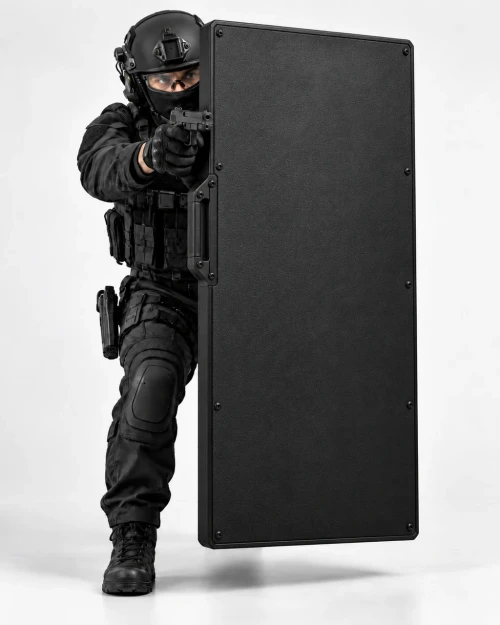
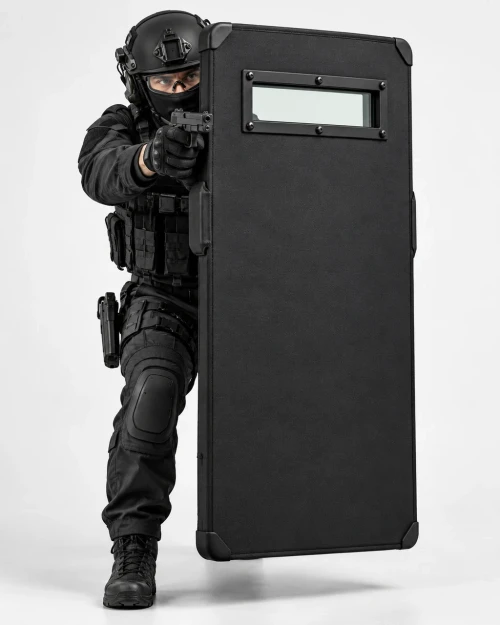
A Level IIIA ballistic shield without a viewport is a solid ballistic panel that stops handgun threats and fragmentation across its entire surface, with no transparent aperture cut into it. Removing the viewport makes the shield lighter and less expensive than an equivalent panel with one, which is why no-viewport shields are the common choice for patrol carry and for teams buying shields in quantity.
We supply Level IIIA shields in both configurations and spec them to the mission. Tell us who is carrying it and what they are walking into, and we will recommend the right panel.
Request a Quote
Typical response: one business day.
Should you buy a ballistic shield with or without a viewport?
Choose a no-viewport shield when weight, cost, and uninterrupted panel coverage matter more than seeing through the shield. Choose a viewport when the operator must hold cover and maintain a sightline at the same time.
| Factor | No viewport | With viewport |
|---|---|---|
| Weight | Lighter | Heavier over the aperture |
| Cost | Lower | Higher |
| Panel coverage | Uninterrupted | Interrupted by the aperture |
| Sightline while covered | Over or around the shield | Through the viewport |
| Best suited to | Patrol carry, fleet buys, extended holds | Entry, barricade, approach |
Most agencies buying their first shields start here, then add viewport models for entry teams as budget allows. If you are deciding between the two, we will walk you through it — see the viewport version of this shield for comparison.
What does a Level IIIA ballistic shield stop?
NIJ Level IIIA is the handgun and fragmentation rating. Under NIJ standard 0108.01, Level IIIA addresses the common duty and street handgun threats:
- 9x19mm FMJ
- .40 S&W FMJ
- .45 ACP
- .357 Magnum JSP
- .357 SIG FMJ
- .44 Magnum SJHP
- 5.7x28mm
- 12 ga. slug
Level IIIA does not stop rifle rounds. Stopping 5.56 or 7.62 requires a Level III or III+ panel, which weighs more and costs more. If your threat assessment includes rifles, say so on the quote request and we will spec a rifle-rated shield instead. This is the single most common mismatch we correct on incoming requests.
Who uses no-viewport ballistic shields?
Patrol officers carrying a shield in a vehicle. Agencies equipping multiple units on a fixed budget. School resource officers. Courthouse, facility, and corrections security. Tactical teams that pair solid panels with viewport shields depending on the call. Federal and military units buying on contract.
How to spec the right shield
Six answers let us quote you accurately on the first reply.
- Threat profile. Handgun only, or rifle-rated? This sets Level IIIA against Level III or III+.
- Mission. Patrol carry, entry, facility post, EOD approach. Each pulls toward a different size and weight.
- Carry time. Minutes on an entry is a different shield than an hour on a perimeter.
- Size and coverage. Larger panels cover more and move slower.
- Accessories. Light mount, handle configuration, carry strap, storage case, tactical cover.
- Procurement path. GSA, purchase order, P-card, or credit card.
Questions we get about no-viewport Level IIIA shields
Is a shield without a viewport safer than one with a viewport?
Neither is safer. Both carry the same ballistic rating. A viewport is covered by transparent armor rated to the panel's level, so the protection is equivalent. The real differences are weight, cost, and how the operator maintains a sightline.
How much lighter is a no-viewport shield?
Lighter, but the amount depends on panel size and build. Transparent armor is denser than the opaque panel material it replaces, so the aperture adds weight over that area. We will give you the actual figures for the configuration you are considering.
Can a viewport be added to a shield later?
No. The aperture is part of the panel construction, not an accessory. If your team needs a sightline through the shield, buy the viewport configuration up front.
What shield sizes are available?
Several, in both rectangular and cutout profiles. The right size depends on tactics and carry time rather than preference. Tell us the mission on the quote request and we will recommend one with the reasoning behind it.
Do you sell ballistic shields to private citizens?
Ballistic shields are intended for professional use by trained personnel. EOD Gear supplies law enforcement, government agencies, military units, and qualifying security organizations. Availability varies by jurisdiction.
How do agencies buy ballistic shields on contract?
EOD Gear is a GSA contract holder and accepts GSA orders, purchase orders, P-cards, and credit cards. Noting your procurement path on the quote request removes a step from the cycle.
Get a quote
Tell us your threat profile and mission and we will come back with a specific recommendation, an official quote, and a straight explanation of why that shield and not a different one. If the right answer costs less than the shield you asked about, we will tell you that.
Or call (938) 336-3639 · govsales@EOD-gear.com